Showing posts with label Mexico. Show all posts

Tuesday, July 4, 2017

Edward William Johnston to John Warfield Johnston, December 29, 1847

[Edward William Johnston at Washington, D.C., to John Warfield Johnston at Richmond, December 29, 1847. Box 26, folder 9, Robert Morton Hughes Papers, Special Collections and University Archives, Patricia W. and J. Douglas Perry Library, Old Dominion University Libraries, Norfolk, VA 23529. This is my rough, annotated transcription from a copy graciously provided by William Myers. Extra paragraph breaks inserted for easier reading.]

Washington, D.C. 29 Dec. 1847

My dear John

Your letter, though delayed by that profound stroke of economy which makes the delight of Cave Johnson & the wonder of the Democracy – the stroke, I mean, by which he now gets the Mail carried for three days (from here to Richmond) at no more than he formerly gave for carrying it [in] one day – has been received & attended to.

I have visited the war office; procured there certain documents which you will see; and found the two officers who will be able to give the best history of Joseph’s campaigns & his other services.

The latter may take some days for its preparation: meantime, I wrote merely to say that you will, by the end of this week, have all that you want.

About a week since, I received from Joseph. Though Col. Andrews, the sword & watch of our dear & gallant boy, Preston, which he wore when he fell. It might be possible to mention, in your proceedings, the poor youth, than whom none stood higher in the army. The watch is that which his father had on, when he too perished in the public service. As for a sword, Jo wields another – that which his father used with so much honour at Eutaw Springs & when he led the Forlorn Hope at the taking of Fort Watson.   

                                                affectionately yours
                                                 Edward W. Johnston
[John Warfield Johnston (1818-1889).
Edward William Johnston (1799-1867).
Cave Johnson (1793-1866), Postmaster General. Introduced postage stamp into the US mail system. 
Joseph, Jo = Joseph Eggleston Johnston (1807-1891).
Col. Andrews = Timothy Patrick Andrews (1794-1868) of the Voltigeurs.
Preston = John Preston Johnston (1824-1847).
His (Preston’s) father = Charles Clement Johnston  (1795-1832).
His (Jo’s) father = Peter Johnston, Jr. (1763-1831).
Eutaw Springs = September 8, 1781.
Fort Watson = final assault, April 23, 1781.]

[Many thanks to Sue Davis, William Myers, Mary Davy and Sally Young for their ongoing research collaboration; in this case, specifically to William for providing a scanned copy of the original document.]


Thursday, February 23, 2017

Joseph E. Johnston to Robert Milligan McLane, January 24, 1850

Closeup, San Antonio in 1849 by William G M Samuel, Bexar County Courthouse
[Joseph Eggleston Johnston at San Antonio, Texas, to Robert Milligan McLane at [Washington City], January 24, 1850. Box 3, Louis McLane Correspondence (1795-1894), MSS 57083, Library of Congress. This is my rough transcription. Added paragraph breaks inserted for easier reading.]

Since writing you from Austin, my dear Bob:

I find that my movements have been premature. The report of the Sec: of War has come to my hands since then. I accordingly apologize for my haste, but can't refrain from calling to your attention to some portions of that report.

The accompanying pamphlet contradicts emphatically what is said of the peaceful condition of this frontier, & the statements in it are far short of the truth -- because in Austin full evidence was not to be had.

Since the printing of this pamphlet intelligence has been received of the murder by Indians of an agent sent by the Legislature to the Lower Rio Grande to ascertain the extent, in that quarter, of Indian depredations.

I am safe in asserting that there is never less than one plundering party within the settlements, & then, we are bound by the last treaty with Mexico to keep our Indians out of that country.

Now all the Indians of this S.W. region have been taught that Mexico is their natural prey, & that plundering Mexicans is the only manly mode of subsistence -- for variety's sake they occasionally turn off into Texas.

Now six hundred miles at least, of the Rio Grande is without an American soldier, because we have none to place on it, & this is the very frontier that the Indians are & have long been in the habit of crossing into Mexico.

The troops we have on the occupied parts of the Mexican frontier are infantry, & therefore of little efficiency in the pursuit of the prairie Indians. As to the idea of mounting the foot soldiers on emergencies, you know as well as any one how fit they usually are for cavalry service, & how fit muskets and bayonets are for cavalry arms. Two mounted regiments (additional) would not be more than sufficient in the fulfillment of this treaty obligation.

Corrections in abuses of brevet commissions in the way of pay, we recommend. If you will examine the military laws, including articles of war, you'll find that the remedy is already in the hands of the executive. The present abuses are by regulations of the war department, contrary to law -- see in opinions of attorney general, Mr. Wirt's opinion on the subject of brevet pay. You will benefit the army, tho: by abolishing this sort of commission.

There is another recommendation, the injustice of which you will understand, when you read it. To make senior staff officers, in certain cases & for certain purposes, to a certain extent subject to be commanded by their juniors of the line -- this for the sake of harmony.

Such evils as are referred to do exist, but they come from a disregard on the part of the govt., of existing military organization, of European experience, in the establishment of an enormous qr. master's dept. independent of the regimental organization, & in giving military rank to the civil branches of the service -- surgeons and paymasters.

The remedy therefore is not in continuing to overturn established principles & usage, but in undoing the measures which produced the evils complained of. Because medical officers ought to be under the command of the commanders of their posts it does not follow that an old field officer of Engineers who has served in the front of every campaign, perhaps, since the revolution, should be inferior in military rank to any 2d Lieut:

It isn't necessary to argue these matters with you; but it is a relief sometimes, you know, to express oneself in such a case. I can't do so to the author, & therefore make a victim of you.

Tell Caldwell howdy for me.
                                                                      as ever
                                                                       J. E. Johnston
                                                                
[Captain Joseph Eggleston Johnston (1807-1891), Topographical Engineers 
Robert Milligan McLane (1815-1898)

Secretary of War = George Walker Crawford (1798-1872)
Caldwell = George Alfred Caldwell (1814-1866)]


[Many thanks to Sue Davis, William Myers, Mary Davy and Sally Young for their ongoing research collaboration.]  

Monday, February 20, 2017

Joseph E. Johnston to Robert Milligan McLane, December 10, 1849

San Antonio in 1849 by William G M Samuel, Bexar County Courthouse
[Joseph Eggleston Johnston at San Anonio, Texas, to Robert Milligan McLane at [Washington City], December 10, 1849. Box 3, Louis McLane Correspondence (1795-1894), MSS 57083, Library of Congress. This is my rough transcription. Added paragraph breaks inserted for easier reading.]

My dear Robert

While in the neighborhood of El Paso I received a letter from you which I have been unable to answer till now. Altho' 'tis more than a fortnight since my return to this place, the settlement of my accounts with individuals & 3 departments in addition to my current duty has occupied me so closely that I have not attempted a letter till now.

I found my poor Lily heart-broken, & well she might be -- none but yourselves ever lost such a mother -- her absence from the death bed is an additional cause of grief. She is absolutely pining to see her mother's grave, & to contribute, with you, to give your father such comfort as he can feel, & would now be at Bohemia but that I fear the effect of such a change of climate -- she has derived perceptible benefit already from the change to this, & I have strong hope that the winter here will restore her health.

We are now grieving, my dear Bob, for your last misfortune, which we learned by the last mail. Lily had been enjoying in anticipation of finding a boy of yours to play with on her return, & is now afflicted next to yourself -- I fear now to see a mail -- every one brings something to revive almost in its fullest bitterness grief for your mother's loss. I find one comfort however. This climate of Texas agrees admirably with Lily so far. She looks better now than at any time in the last six or seven years.

All that I have seen in the newspapers to gratify me has been concerning you. Of course during my absence nothing of what was going on in the world ever came to my knowledge. Your letter came by the merest accident. I find however you were elected by a majority so large that you have acquired vert great influence over your district. I see you proposed in many of the papers, for speaker of the house. However the election may have resulted, this proves that you have succeeded rarely in public life. Indeed I believe that few if any have in so short a political life as yours has been, gained so high a position, & at this I proudly rejoice.

There are two members of your house that I want you to find out. One is Col: Caldwell of Kentucky late major of Voltigeurs, & my mess mate, a true gentleman & democrat. The other is the representative of western Texas, whom I have never seen. But I have had his brother, Rich'd A. Howard with me since last spring, & he is a jewel. One of the truest men I have ever met. So I think the representative must be something of the same kind.

I shall write again in a day or two. Lily joins me in love to Georgine & the little ones.

                                                                  As ever
                                                                  J. E. Johnston

[Joseph Eggleston Johnston (1807-1891)
Lily = Lydia Milligan Sims McLane Johnston (1822-1887) 
Robert Milligan McLane (1815-1898)

Their mother = Catherine Mary Milligan McLane (1792-July 31, 1849)
Their father = Louis McLane (1784-1857)
Caldwell = George Alfred Caldwell (1814-1866)
Volney Erskine Howard (1809-1889), who later moved to California.
Richard Austin Howard (circa 1824-1866)
Georgine = Georgine Urquhart McLane (1813-1899)
Little ones = Mary Emma McLane (1843-1869) and Georgina Urquhart "Jennie" McLane (1846-1915). The latter lived in Paris from 1885 until her death in 1915.]


[Many thanks to Sue Davis, William Myers, Mary Davy and Sally Young for their ongoing research collaboration.]  

Saturday, February 4, 2017

Edward William Johnston (as "Il Secretario"), January 2, 1845

[Edward William Johnston writing under the nom de plume "Il Secretario." Richmond Whig and Advertiser, Volume XXII, Issue 1 (January 7, 1845), page 1. Extra paragraph breaks added for easier reading.]

WASHINGTON, Jan’y 2, 1845

A press of occupations has for some days denied me the opportunity of writing either to you or to my venerable and cherished friend near you. I am sure that the perfect identity of his style and mine, and our plentiful lack in common of wit must have often led you to suspect that I wrote many of the Enquirer’s “leaders.” Why, then should I deny the “soft impeachment?” But, then, Mr. Ritchie and I systematize and subdivide our joint loving labors. He does the quotations, supplying all those gems of original learning and taste that glisten adown the columns, like orient pearls at random strung. He has mines of that sort of erudition, the astonishing man – no less than six quotations from Dr. Dodd’s “Beauties of Shakespeare,” three from a book that Mr. Jefferson sent him called “the Bible,” and two from a rare author called Cowper. One of them runs thus: “Oh for a lodge in some vast wilderness,” and refers, I believe, to certain farms of Texas. The other is something about “I am monarch of all I survey,” and is supposed to allude to some floating Land Grants in the same Promised Land. 

He furnished all the French, too; which, you know, is of a quality that has long kept all Gaul in astonishment. He likewise does the History; for I assure you that the splendid discovery that Colbert was Minister of France to Louis the XVI is his, not mine. The “fine writing” is also his, undoubtedly – though, occasionally, the imaginative powers of the elder junior and the fervid genius of Tommy erect themselves into a sublime that almost rivals the paternal. They, in short, do the fancy (which you know is the richest) the erudition (which is perfectly ponderous) the Abstractions (which are of the very thinnest) and the fictions generally, which for boldness of invention soar a little higher into the empyrian than ever Pegasus winged before except that immortal Subverter of all fact, the great Ferdinand Vendez Pinto, the acknowledged prince of prevaricators. 

But if you ever see such humbler things in the Enquirer as a little sound argument, an atom of common sense, a touch of manliness, a ray of charity, a bit of sincerity, a momentary gleam of honesty, or a joke that is not fitter to make one cry than laugh – lay your hand upon your heart or crook your arm and swear that I did it! So, now, having made my confessions, let us pass to matters here.

They have not yet taken a very decisive form. The Democracy is a little be-fogged on the great questions, Texas and the Tariff. On which side it will emerge, no eye can yet discover. They have a great longing, in both cases, to keep their promises; for they are religiously observant of their engagements to do ill. Here, however, they pause, apprehensive that they may hurt – not others (for that were a small matter) but themselves. 

Meanwhile, by way of solacing their love of mischief, they threaten a little from time to time, to break up the Oregon negotiation, or amuse themselves with efforts to worry brave little Rhode Island and pull down her government about her ears. They have been at the latter pastime to-day.

As to Texas, they have held, on Saturday, one caucus, and are probably at brawls in another, to-night. In the former, there are said to have been many violent Southern propositions and speeches, met by as many cool Northern moves to make them all abortive. 

Finally, a postponement and a committee of compromise was resorted to – it is said, with no sincerity on the part of the North. The Report and final decision were to be to-night. You will perceive that they already have before them, openly , near a score of plans: probably as many more are yet to be divulged; for, it being taken for granted that rapine is a thing easily make acceptable to “the greatest land-stealers upon earth,” and that national robbery is a thing at which any knave is expert enough, every blockhead seems to have his Joint Resolution of Annexation. 

That single word, inasmuch as it avoids saying “Plunder,” dispenses with all other colorings of right or policy or sense or decency. 

Henceforth, if a man wants his neighbor’s house or wife's purse, let him ‘annex’ the same. If you have sold a thing, put the cash or other consideration into your pocket, button it up tight, and then “re-annex” it. 

Thus you see that the only difference lies in the Re: when you impudently say that you will have a thing without a title, that’s Annexation: and when you choose to say that you once had a claim, that’s Re-Annexation.

I have reason to believe, however, that the skilful doubler whom you celebrated the other day, Mr. Dromgoole, thinks that it is he who will bring matters about; and his crafty guesses at what can succeed may be much relied on. He thinks that all the positive measures will be defeated, and that a Resolution (to be moved by him) that it is expedient that Texas be annexed, will be the utmost that can be done. 

That, you see, will involve no action, and only be a declaration of opinion: and as the opinion of such a House is (as he knows) of no sort of weight with any body, the step will not be of the slightest consequence. The Globe, on the other hand, is positive that the thing will pass; but divested of all detail, in the simple and concise form that Texas be and is annexed.

The dynasty that is to be display an unexpected caution, amounting to timidity, as to committing itself to men or measures. Mr. Calhoun’s incredible follies have probably made them afraid of him and forfeited all the vantage he at first held. Never did any one of reputation exhibit such astonishing fatuity. What a rapid havoc he has made of such respect as was left him -- that of ability.

As I do not write to the Enquirer to-night, please let my loving friends know that when they can either write or fight or speak the truth, “the hero of the Liberty school” may conceive some little apprehension at the wrath or vauntings of “the Heroes of Hobbes’s Hole.” Dogs as they are, they may whine when I lash then: but let them bark at me, if they dare!

IL SECRETARIO

[Mr. Ritchie = Thomas Ritchie (1778-1854), editor of the Richmond Enquirer, supporter of Democratic President-Elect James Knox Polk (1795-1849) and the annexation of Texas. Thomas Ritchie, Jr. (1819-1854) took over the newspaper when his father was invited to Washington City by Polk to start another one. The younger Ritchie fought a pistol, swords and knives duel with Richmond Whig editor (and friend of Edward William Johnston) John Hampden Pleasants (1797-March 1, 1846) on February 22, 1846, mortally wounding him. 

Mr. Dromgoole = George Coke Dromgoole (1797-1847), US Congressman (Jacksonian Democrat).

Mr. Calhoun = John Caldwell Calhoun (1782-1850), pro-annexation Secretary of State under outgoing President John Tyler (1790-1862) and Senator from South Carolina until his death in 1850. 

Edward William Johnston (1799-1867), as Il Secretario and a Whig, opposed annexation and the Democrats (aka "The Democracy") in general.] 

[Many thanks to William Myers, Mary Davy, Sally Young and Sue Davis for their ongoing research collaboration.]


Tuesday, January 3, 2017

Joseph E. Johnston to Robert Milligan McLane, February 28, 1848

[Joseph Eggleston Johnston at Tacubaya, Mexico, to Robert Milligan McLane at Washington City, February 28, 1848, Box 3, Louis McLane Correspondence (1795-1894), MSS 57083, Library of Congress. This is my rough transcription. Added paragraph breaks inserted for easier reading.]

My dear Bob

Col. Andrews was desired by the officers of his regiment to try in Washington to get the prescribed uniform of the regt changed -- from grey to dark blue or green-blue being generally preferred. I have just received from the adjt genl a copy of a long report of his to the Sec: of War accompanying a letter of Col: A's on the subject. The report is adverse, & as the Adjt. Genl's opinion is probably influential, I want you to counteract its effect. Wise men in general regard the color of coats & trousers as unimportant matters, & doubtless they are so, but in the army uniformity of dress is admitted to be desirable, & the argument against grey among the Voltigeurs is that it has never been furnished by the U.S. to the men & we can't obtain it here, so that the Qr Mrs [Quarter Master's / Quartermaster's] dept is having nothing for the army made in Mexico was compelled to give us dark blue. The officers have all attempted to wear grey, but as they have purchased their clothing in different parts of the U.S., no two wear the same shade. It was to enable the officers to wear uniform that a change in the prescribed dress was proposed, after it had been ascertained that in Mexico at least, without such change, they can not appear in uniform, or in a dress corresponding to that of the soldiers.

The adjt genl's argument is that the dress of "Foot riflemen or light corps has always been green or grey" & that "blue has always been the distinctive color of uniform for Infantry, Artillery or Dragoons" & that "it is believed to be the opinion of the army generally that the dress of light corps should be peculiar & easily distinguished from that prescribed for heavy troops of the line." He adds that the change would involve heavy pecuniary loss to the govt, supplies of grey clothing having been sent to Vera Cruz. In regard to the first argument our whole army previous to this war for at least 15 years, has worn blue. Cavalry Md Riflemen & light arty are all light troops. In regard to the other, the clothing in question has been issued to volunteers -- a large supply just arrived for the army, from Vera Cruz has in it no grey -- & in addition, the whole army laughs at the color.

I write to you on this subject because you know it is useless to attempt to change the A Genl's opinion on any subject -- after he has put it on paper -- so I want you, if it has not been done, to go to the Sec: of war on the subject.

I am infinitely disgusted to find that my Col: so far from resigning, as he pledged himself to do, is retaining his commission in order to come here as fiscal agent -- a perfect fifth wheel, the disbursing officers say. This of course prevents the possibility of my promotion. For this civil appn will be held during the war. So I lose the object for which I joined this regiment -- a colonelcy.

Every body here is now confident of peace. You know more of it, however, than we here. I am just ordered with my regiment to join Cadwalader at Toluca, about 40 miles to the S.W.  

My love to Georgine & the little ones.

As ever J. E. Johnston

[Joseph Eggleston Johnston (1807-1891)
Robert Milligan McLane (1815-1898)
Col. Andrews = Timothy Patrick Andrews (1794-1868), creator of the flexible Andrews or Voltigeur Hat. 
Adjutant General = Roger Jones (1787-1852)
Secretary of War = William Learned Marcy (1786-1857)
George Cadwalader (1806-1879)
Georgine = Georgine Urquhart McLane (1813-1899)
Little ones = Mary Emma McLane (1843-1869) and Georgina Urquhart "Jennie" McLane (1846-1915). The latter lived in Paris from 1885 until her death in 1915.]

Map closeup from: Hardcastle, Edmund L.F. (engineer). Map of Battle of El Molino del Rey (issued 1850). Philadelphia, Penn.: P.S. Duval Lithographers, 1850. From Rice University.  http://hdl.handle.net/1911/21772
  
[Many thanks to William Myers, Mary Davy, Sally Young and Susan Davis for their ongoing research collaboration.]
    

Monday, January 2, 2017

Joseph E. Johnston to Robert Milligan McLane, January 12, 1848

[Joseph Eggleston Johnston at Tacubaya, Mexico, to Robert Milligan McLane at [Washington City?], January 12, 1848, Box 3, Louis McLane Correspondence (1795-1894), MSS 57083, Library of Congress. This is my rough transcription. Added paragraph breaks inserted for easier reading.]

My dear Bob,

I found yours of the 5th Nov. on my table this morning, on my return from our friend Irwin's funeral. He died on the 10th after an illness of a few days, universally lamented. I need not make his eulogy to you, as far as personal qualities & personal worth are concerned. But may tell you that no one in this army has gained more reputation in the last campaign.

As the mail goes tomorrow I saw general Worth immediately, & he promised to send you by the British carrier who will beat our mail by 10 days, a copy of a letter of his to the Sec: of War giving his views on the manner of conducting our operations in this country. He showed me the letter. I disagree with him only in regard to the force necessary to carry out his plan. He names 40000. I name 100000. Because if the govt names 100000 we may get 40000 or 50000 for service in Mexico, & after throwing that force into this country a degree of energy not often exhibited by an executive of our[s] will be required to keep the Army up to the standard. Notwithstanding all we have seen in the news papers concerning large reinforcements & the activity of recruiting not half so effectives. It is said that the Sec: of War reports General Scott's Army, from Vera Cruz to Mexico, at 32,000. We estimate it at about 15000 or 16000 many of whom are in hospital, & our people leave the hospitals only to go home as unfit for military service. 

So you see what provision you must make, in Congress, if you determine upon occupation -- not defensive, for that would be a farce, & an interminable one. No one here believes the "conquest of peace" feasible. The Mexicans have undoubtedly been much encouraged by the apparent eagerness of our govt. to treat. I believe myself that the presence of a commission with our army took away whatever chance of peace might have been. You will have, I think, two places to choose between -- the first disgraceful, viz: to purchase the boundary you indicate, for about $30,000000. Instead of receiving the additional territory as indemnity, & it is generally supposed that some such proposition has been transmitted to Washington by our late comr, & that he is waiting here for a new appt. & authority to treat on such terms. I hope not. 'Twould be worse than an armistice. The Mexicans will leave you no other resource [recourse] than occupation -- offensive occupation you term it. For of course even fanaticism wouldn't, by a quiet withdrawal of our troops, confess a failure, & agree that so much brave blood should have been shed in vain.

This occupation would be no more expensive to the U.S. than the present system. By occupying in force the capitals of all the states, & the richest mining districts, disregarding at present the sections of country, yielding little revenue, we could maintain a large army & civil gov. at the same time on the resources of the country, & at the same time diminish by half the burdens upon the inhabitants. This would gradually strengthen a party friendly to us, & as that party grew, we might, like the British in India, make a sepoy force. With no Mexican officers. At the same time the U.S. would derive immense commercial advantages from such a state of things -- taken in connection too, with the condition of England. We should have almost a monopoly of the rich trade of this country, & the influx of gold & silver would make us instead of England. We should have almost a monopoly of the rich trade of this country, & the influx of gold & silver would make us instead of England, the Bankers of Christendom, & the first commercial nation in existence. Might not such probabilities reconcile our northern brethren to the idea of conquest & extension to the South? The scheme of defensive occupation would be far more expensive to the U.S. than the foregoing -- because we should depend upon home for every thing. The expence [expense] of disposing the troops on so long a line would be enormous, as well as that of keeping recruiting -- your garrisons & transporting supplies of all sorts to such distances in the interior. I am very glad that such an absurdity is not likely to be adopted.

The character of our troops is much deteriorated, even in the old regiments, which are also much weaker than in the beginning of Aug. They have lost nearly if not quite half their officers -- losses which will require years to replace. My own regiment has lost about 2/3 of the enlisted men brought into this valley. By the way, we require for riflemen better people than the regiments of the line, more vigorous active & intelligent men. If there is a proper spirit in Congress they will improve the national army very much by allowing the Voltigeurs a little more pay than infantry -- no matter how little -- just enough for a distinction -- it would enable us to get the best men. As for the public advantage, we should. If you can do that, get the Howitzer battery as an 11th compy [company] making R. P. Hammond 3d Arty Capt & J. L. Reno ord. Dept. First Lt. you'll [render] the state much service. Then get Talcott's leg cured & himself sent back to the regt & you'll be doing poor little Lyd & myself a service -- for then & not till then I may set off. Tell them to send us no more new generals -- we now have no others. It is exceedingly disagreeable to find your life & reputation depending upon one who don't know the difference between light & garrison duties.

My love to Georgina & the little ones. I send a copy of Turnbull's map by Elzey (Arnold Jones). The positions given our troops at Molino del Rey & Chapultepec & Santa Anna's at Contreras are all wrong. So are the reports of the genls of divisions, except Worth's. Quitman's report of the 13th is a farce, particularly what relates to Chapultepec. It is said that he had a picture made to correspond, & took it to N. O. [New Orleans] to be lithographed -- a new sort of bulletin [allusion to Napoleon's habit].

[Lieutenant Colonel Joseph Eggleston Johnston (1807-1891)
Representative Robert Milligan McLane (1815-1898)
Irwin = Captain James Ramsey Irwin (1800-1848), First U.S. Artillery, Chief Quartermaster of General Winfield Scott's army.
Secretary of War = William Learned Marcy (1786-1857)
General Worth = William Jenkins Worth (1794-1849)
General Scott = Winfield Scott (1786-1866)
R. P. Hammond = Richard Pindell Hammond (1826-1891), USMA Class of 1841. Moved to San Francisco after the war and became California Speaker of the House, among other things.
J. L. Reno = Jesse Lee Reno (1823-1862), USMA Class of 1846

Talcott = George Henry Talcott (1811-1854)
Lyd = Lydia Milligan Sims McLane Johnston (1822-1887)]
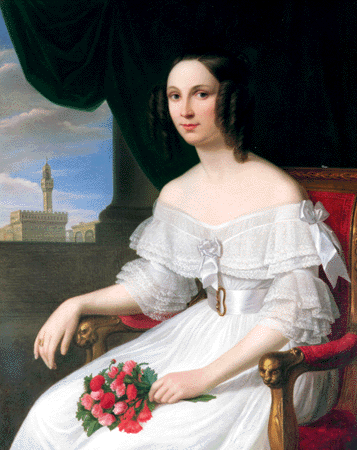
Painting: Georgine Urquart McLane by Franz Xaver Winterhalter1841, Maryland Commission on Artistic PropertyMaryland State Archives, MSA SC 1545-1190

[Georgina = Georgine Urquhart McLane (1813-1899)
William Turnbull (1800-1857)
Arnold Elzey Jones, Jr. (1816-1871)
General Quitman = John Anthony Quitman (1798-1858)]

Map closeup from: Hardcastle, Edmund L.F. (engineer). Map of Battle of El Molino del Rey (issued 1850). Philadelphia, Penn.: P.S. Duval Lithographers, 1850. From Rice University.  http://hdl.handle.net/1911/21772
  
[Many thanks to William Myers, Mary Davy, Sally Young and Susan Davis for their ongoing research collaboration.]

Sunday, January 1, 2017

Joseph E. Johnston to Robert Milligan McLane, January 30, 1848

Source: US Army Center Of Military History (2006)
[Joseph Eggleston Johnston at Tacubaya, Mexico, to Robert Milligan McLane at [Washington City?], January 30, 1848Box 3, Louis McLane Correspondence (1795-1894), MSS 57083, Library of Congress. This is my rough transcription.]

Dear Bob

I send on this sheet a recommendation in the case of a brother of Vogdes of the 1st Art. for commission in the army. It is brought out by the report we have lately received that ten more regiments are to be organized.

In the beginning of the winter several (I think three) recommendations of the same sort were sent to Washington by the officers of Voltigeurs -- of DePew Maguire & FitzHugh -- for this regiment. I have just signed directed to the adjt. Genl. for Sergt. John R. Neidy, also fr Brevet or commission in this Regiment. The men abovenamed [sic] are not only superior to a large majority of the appointments in "the ten" regts. but have the advantage of instruction experience & trial. FitzHugh, too, is a Marylander, I think of Hagerstown, of a highly respectable family, that is to say well educated. The four named in this paragraph I am very anxious to get into the Voltigeurs. If you can do any thing to forward it I beg you not to omit it -- (either commissions or brevets) the latter will interfere with nothing else -- a friend of FitzHugh has promised to send this by an early opportunity.

We have lately received the report of the sec: of War -- As you may discuss the matter of the force to be retained here, it may be well for you to know the difference between the reports of the two adjt genls, Mr. Marcy's & Genl Scott's, the former sets down our force on this line at 32,000. The latter told me yesterday that the effective force in this valley is about 12000 & there are stationed on the road to Vera Cruz, including that garrison, perhaps 4000, or 5000. The 10 regts. organized nearly a year ago have never mustered more than 4000 effectives. Our army now is far less efficient than that which Genl Scott marched from Puebla in August. The great loss off officers of the old army has had great effect upon the character of the old regts. We are in no condition to make detachment, except in the neighborhood. If we are to cover the country you must adopt the European system. Send us soldiers instead of recruits. You know the effect of discipline on the health of troops. Genl Butler's volunteers for instance, have now, after entering the country in the healthy season & no service but an easy march of 250 miles, at least a third of their number in hospital. Keep 1/3 of each regt at home in depot for recruiting & instruction.

Baltimore is so wretchedly represented in the Voltigeurs that I look upon it as the duty of her representatives to obtain the appts above named.

You say that I shall be brevetted, If so make [it] valuable by procuring the president's assignment to di[?] accordingly.

As ever J. E. Johnston

[Joseph Eggleston Johnston (1807-1891)
Robert Milligan McLane (1815-1898)
Vogdes = Captain Israel Vogdes (1816-1889), West Point Class of 1837.
DePew = William R. Depew
Maguire = Glassop (aka Glossop) McGuire (aka McQuire)
FitzHugh = William H. Fitzhugh
John R. Neidy = died 1874
Mr. Marcy = William Learned Marcy (1786-1857)
Genl Scott = Winfield Scott (1786-1866)
Genl Butler = William Orlando Butler (1791-1880)
President = James Knox Polk (1795-1849)]

[Many thanks to William Myers, Mary Davy, Sally Young and Susan Davis for their ongoing research collaboration.]

Sunday, December 4, 2016

Joseph E. Johnston to Robert Milligan McLane, November 22, 1847

Source: US Army Center Of Military History (2006)
[Joseph Eggleston Johnston at Vera Cruz [aka Veracruz], Mexico, to Robert Milligan McLane, M. C. [Member of Congress] at Washington, D. C. November 22, 1847. Box 3, Louis McLane Correspondence (1795-1894), MSS 57083, Library of Congress. This is my rough transcription. Extra paragraph breaks added for easier reading]. 

Dear Bob

Accept my congratulations upon your political preferment It is no doubt as welcome to you as a Colonelcy (when it comes) will be to me. I am one of your constituents, & have therefore a right to make suggestions to you in regard to your duties as a representative. The democratic party is of course deeply interested in the efficiency of our Military organization. Upon which the successful prosecution of the war depends.

The Regiment of Voltigeurs is not quite perfect. It wants an additional company to make it so. Then, with 10 companies of Riflemen & a Howitzer battery, it can maintain itself against all comers. As now organized by law it consists of 9 companies of Riflemen. Every other regiment in the world, you know, has 10 companies. All the systems of tactics known, are based upon that supposition. every body in this campaign has remarked the efficiency & value of the rifle. Another company therefore would, besides completing the organization of the regt., be so much clear gain to our force, & particularly important to a regiment intended, like this, for detached service -- a partizan corps -- Genl Scott observed the defect in the law & as soon as the regt joined his army, organized it as I propose. Manning the Howitzers with a company enlisted by the ordnance dept.This company has been attached to the regiment every since, but is so much reduced by losses in the recent actions that it is now too weak for the service of a battery, & is not recruited. 

Now you might easily attach a clause to the first Military bill that passes adding this company to the regiment. The officers to be appointed by selection (in the first place, vacancies supplied by the M.A. [U.S. Military Academy]). From the Arty. Ord. T.E. [Artillery, Ordnance, Topographical Engineers] &tc.

It is particularly important that a detached bettery like this should have well instructed officers, as they must be thrown generally upon their resources, & be very much out of reach of the aid of the ord: dept. 

The man I should want for Capt. is R. P. Hammond of the 3d Arty, 1st Lieut. Failing him 1st Lieutenant M. Lovell 4th Arty. The 1st Lieut: to be J. L. Reno, 2d Lt. ord: dept. Who comd [commanded] the battery at Chapultepec, as thorough a game-cock as ever fluttered.

Callender, who comd [commanded] the battery when entered the valley was so severely wounded at Contreras that he can't again be fit for such service.

The lower grades might be filled by one or two sergts (Depew & Maguire) who distinguished themselves highly and have been recommended for promotion.

General Quitman whom you will see in Washington, the friend of Hammond & Lovell, promised to interest himself in this affair. So did Gen: Shields. They can do much. You might add to the provision, to be retained on the peace establishment with this organization. The feeling of permanence would improve the regiment much, besides giving us W. P. [West Point] graduates.

I wrote to you from Mexico [City] in regard to life insurance, & had hoped to find the paper here & forward it, but the trunk in which it was left is not to be found -- however, it can't be of any consequence. The premium was $1.83 besides $2.00 for war risk -- on $3000 -- the war risk ought to be reduced as the fighting is mainly done.

The country is getting full of new generals. Men who, I hope, were "born to command" -- otherwise God help the commanded. It is impossible to say how the Army values Genl Scott's health & safety.

The old gent. (Patrick) at my elbow sends his regards & felicitations on your election. Miles has had a great deal to say about it, and well as little McPhail of the 5th.

I am here in comd [command] of a convoy, & have a larger command than any of our generals of division in the Valley.

As ever
J. E. Johnston 

[Joseph Eggleston Johnston (1807-1891, USMA Class of 1829
Robert Milligan McLane (1815-1898), USMA Class of 1837
Scott = Winfield Scott (1786-1866)
R. P. Hammond = Richard Pindell Hammond (1826-1891), USMA Class of 1841. Moved to San Francisco after the war and became California Speaker of the House, among other things
M. Lovell = Mansfield Lovell (1822-1884), USMA Class of 1842
J. L. Reno = Jesse Lee Reno (1823-1862), USMA Class of 1846
Callender = Franklin Dyer "Frank" Callender (1817-1882), USMA Class of 1839 
Depew = William R. Depew
Maguire = Glassop (aka Glossop) McGuire (aka McQuire)
General Quitman = John Anthony Quitman (1798-1858)
Gen: Shields = James Shields (1810-1879)
Patrick = Thomas Patrick Andrews (1794-1868)
Little McPhail = Daniel H. McPhail (1813-1884)
Miles = [?]

[Many thanks to William Myers, Mary Davy and Sally Young for their ongoing research collaboration.]

Saturday, November 26, 2016

Joseph E. Johnston to Robert Milligan McLane, October 17, 1847

[Joseph Eggleston Johnston at Mexico (Mexico City) to Robert Milligan McLane, attorney and councilor at law, Baltimore, October 17, 1847. Box 3, Louis McLane Correspondence (1795-1894), MSS 57083, Library of Congress. This is my rough transcription. Extra paragraph breaks added for easier reading]. 

My dear Bob,

Our friend Jim Irwin has promised to send another note (he first offered to send one to Lily which is in his hands) & I am now writing at his table. [H]e is to send them by a Mr. Landa, if you should see that gentleman he may give you a good deal of information concerning this country & our army. Subjects which in a brief note I cant [can’t] touch upon.

In November last I had my life insured against all sorts of deaths, civil & military for 7 years, paying in yearly – by some mistake I brought away with the paper, which is now in my trunk at Vera Cruz. The Rate is, I think including the war risk 3.83 per cent. The office of the company in Market St at the corner opposite the post office. Mr. Phenix in charge of the office.

Some day when at leizure [leisure], or as nearly so as you ever are, do stop in & arrange this matter for the next year. I can’t send money by such an opportunity, but Lily can furnish what this requires. The insurance is on $3,000 – you needn’t tell her for what purpose you want it. Say a debt of mine.

One more commission. There is a vacant Colonelcy of infantry, Colonel Ransom having been killed at Chapultepec. Whenever you go to Washington ascertain both if I am eligible for that promotion (I am senior Lt. Col.) & if it is probably expedient.

Here it is considered as certain that the Voltigeurs will be retained. Especially since the last action, in which they had a leading part & made some reputation.

Talking of reputation, George has richly earned a brevet in the late actions. He is making a capital soldier. He has not only behaved well & gallantly in every action but discharged his current duties zealously. He is a favorite too in his regiment – that is among the decent people – his only quarrel was with one who had bullied every body else -- & whom is completely exposed.

We expect nothing fit to be called war hereafter, but no treaty of peace. Consequently the country is exceedingly dull, especially this city. I hope you are elected to Congress by this time – if so have the canal in Tihiuantipec [Tehuantepec] commenced at once. It will be very convenient for those stationed in California & the Voltigeurs are prominent candidates for that service. Tho’ I must confess that the advantages of the canal aforesaid, wouldn’t take away my preference for the east side of the Rocky Mountains.

My love to Georgine.
As ever J.E.J.
J.R.J. sends his regards to you & yours

[Jim Irwin = [?]
Lily = Lydia Milligan Sims McLane Johnston (1822-1887)
Colonel Ransom = Truman Bishop Ransom (1802-1847)
George = Lieutenant George Baldwin McLane (1826-1860), Regiment of Mounted Riflemen, later killed in a skirmish with Navajo in New Mexico
Georgine Urquhart McLane (1813-1899)
JRJ = [?]]

[Many thanks to William Myers, Mary Davy and Sally Young for their ongoing research collaboration.]